



We tend to make two oversights when analysing a starting 11 as football consumers.
Firstly, we rarely give enough consideration to match sharpness or general fitness. Managers are often lambasted for overloading a player with too many minutes that lead to injury and, in the same breath, criticised for resting them. Line-ups are rarely picked in ideal circumstances, with an injury in one area or a lack of form elsewhere often forcing a player out of position. The knock-on effects can be felt throughout the team.
Secondly, we often think only about how a starting XI will look in possession and not out of possession, a phase of play just as, if not more, important to some managers.
Both of these slices of context help answer a question constantly asked among the Rangers support: why does Danny Rohl keep playing Djeidi Gassama on the right?
Gassama scores more often from the left
For anyone who has watched the young French winger this season, there is little debate that he is more comfortable and more effective from the left. All eight of his goals in all competitions, six in Europe, have come from that flank. His last standout moment, a run the length of the pitch before setting up Youssef Chermiti to complete his hat-trick in a 4–2 win over Hearts, also came from that side.
It is on the left that the 21-year-old, for whom the Rangers Review revealed a £10 million loan-to-buy offer in January from Monaco, was rejected, feels at home. Gassama’s pace over short distances allows him to cut to the byline or beat defenders from the right, but it is when he can jink infield and drive toward goal that he truly thrives.
A 1–0 win over Motherwell just after Christmas was arguably the only occasion where Gassama excelled on the ball from the right this season. His final ball, often inconsistent, was precise, and one effort after chopping inside on his left was parried into the path of Thelo Aasgaard, who scored the winner.
So, if Gassama is at his best from the left, and, as the Rangers Review recently argued, perhaps most effective as an impact substitute when the game is stretched, why does Rohl keep starting him on the right?
The two reasons mentioned earlier help explain Rohl’s thinking: he is working within realistic, not ideal, circumstances, and his tactical approach involves the team’s structure off the ball as well as on it.
Rohl's three reasons for Gassama on the right
Asked about Gassama’s position at a recent press conference just before the turn of the year, Rohl offered a detailed insight:
“We have, at the moment, a lot of players who love to play on the left winger position. I think this is a part. Then, when you look at the game back, our option B in pressing was to have Gas on the last line when we had an underload with a back four.
“That was the reason why Gas can do this, he did this as well in the home game against Kilmarnock [a 3–1 win in Rohl’s debut]. Yeah, he is, in this case, defensively a bit of a hybrid for me in some moments and this was the reason why I put him in this position.
“I think he has his strengths on the left side with the inside dribbling, but on the right side, he also comes very often into good opportunities and to good chances and now it is about also starting to score in these moments. But he understands, I explained this to him, we have a favourite position but it is also about what is best for the team.”
There are three core components to the answer: the make-up of the squad, Rangers’ off-ball approach and what is best for the team.
The make-up of Rangers' squad and practicality
First, Rangers’ squad remains in transition, as it has for several years. Rohl has only overseen one transfer window, and the contrast between his style and Russell Martin’s inevitably creates areas of conflict. That is partly why Rangers signed what one source described as “physical monsters” in January.
Andreas Skov Olsen has yet to make the impact expected. Rohl prefers Oliver Antman on the left rather than the right, while Mikey Moore is also more comfortable inverting from the left into central pockets, lacking the explosive power required to operate effectively on the right. In theory, Gassama can be isolated with his pace and power on the right while Rangers crowd the ball more on the left.
Meanwhile, Tuur Rommens offers more natural width on the left than Dujon Sterling, while James Tavernier, though still influential, can no longer cover as much ground as in previous seasons. In short, several attacking players prefer the left, and Gassama is viewed as the most adaptable of them all.
Hybrid players and tactical flexibility
Second, Rohl describes Gassama as a “hybrid” player who offers him tactical flexibility.
Although the German has leaned on an aggressive two-striker 4-2-2-2 setup since January, his first few months involved alternating between a back three and a back four. He wants to use both systems to maintain unpredictability and fluidity, especially against opponents who defend with a back five.
Playing Gassama on the right helps Rangers avoid being 'underloaded' in a back four. In football terms, an overload means having more players than the opposition in a particular zone, while an underload is the opposite. Since January, Rohl’s Rangers have consistently looked to overload the final line and the penalty area.
Conversely, Rohl wants to prevent opponents from doing the same. Deploying Gassama in this hybrid right-wing role makes him a potential extra defender when required, giving Rangers an extra man to cover against an opponent's attacking line, without forcing a midfielder to drop into the back line.


And it is worth remembering that Rangers’ title hopes this season have been built on gritty, pragmatic football, a structure-first approach focused on clean sheets. Off-ball organisation remains non-negotiable.
Assymetry and shifting to the 4-2-2-2
Third, Rohl wants his team to play asymmetrically, deliberately unbalanced on the ball. Chris Powell, his former assistant at Sheffield Wednesday, told the Rangers Review that this term featured in every pre-match meeting.
By making one full-back narrower and one winger wider, Rohl stretches opponents vertically and creates different patterns on each flank. For instance, in Rangers’ 1–0 win over St Mirren last weekend, Gassama stayed wider than Moore, while Tavernier operated narrower than Rommens. Tochi Chukwuani was also deeper than Nico Raskin, who created the game's only goal from a wide right position. Aside from Skov Olsen, Gassama is one of the few players capable of naturally providing width.

However, to win the title, Rangers need more output from all their attackers. Chermiti and Naderi have not posed consistent threats in routine fixtures, Skov Olsen has flattered to deceive, and Gassama remains more limited on the right than the left.
One moment from Sunday’s game summed that up. Gassama cut infield into a congested area and lost possession, visibly frustrating Rohl. You cannot help but think that, had he been on his more comfortable flank, the outcome might have been different.
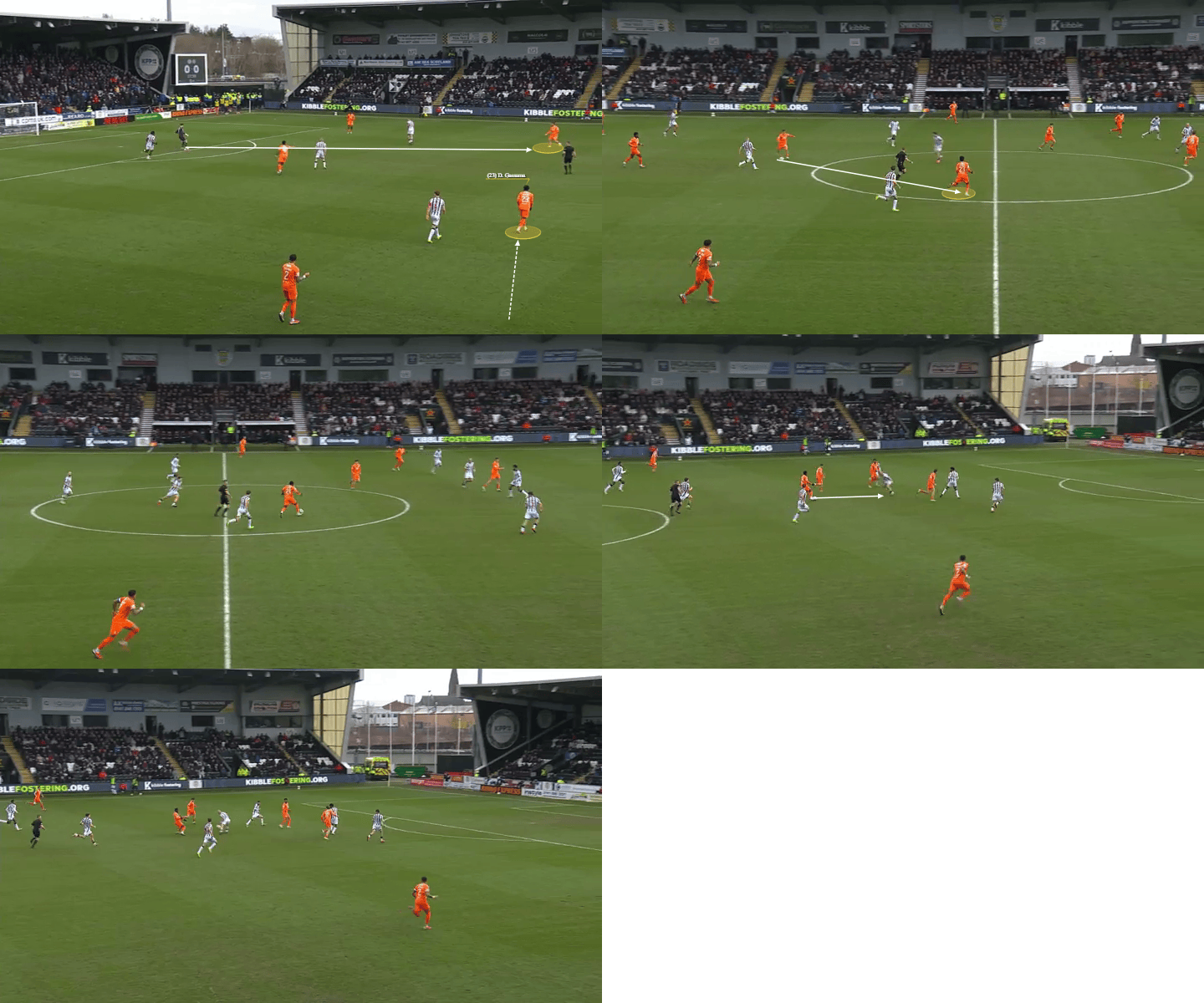
However, this move also provides evidence of how Rohl wants to play in his 4-2-2-2, with wingers who move inside instead of hugging the touchline. Additionally, it's true to say that Gassama could struggle to dovetail like Moore does with Rommens because, even when starting from the left, he isn't as comfortable a creator as the on-loan Spurs man.
As Rohl himself said, Gassama can arrive in dangerous positions, but from the right, he has yet to truly exploit them.
So why persist with the experiment? Because Rangers’ shape, personnel and tactical objectives demand compromise. Like much of Rohl’s early tenure, Gassama’s position on the right reflects that reality more than anything else.


Share